
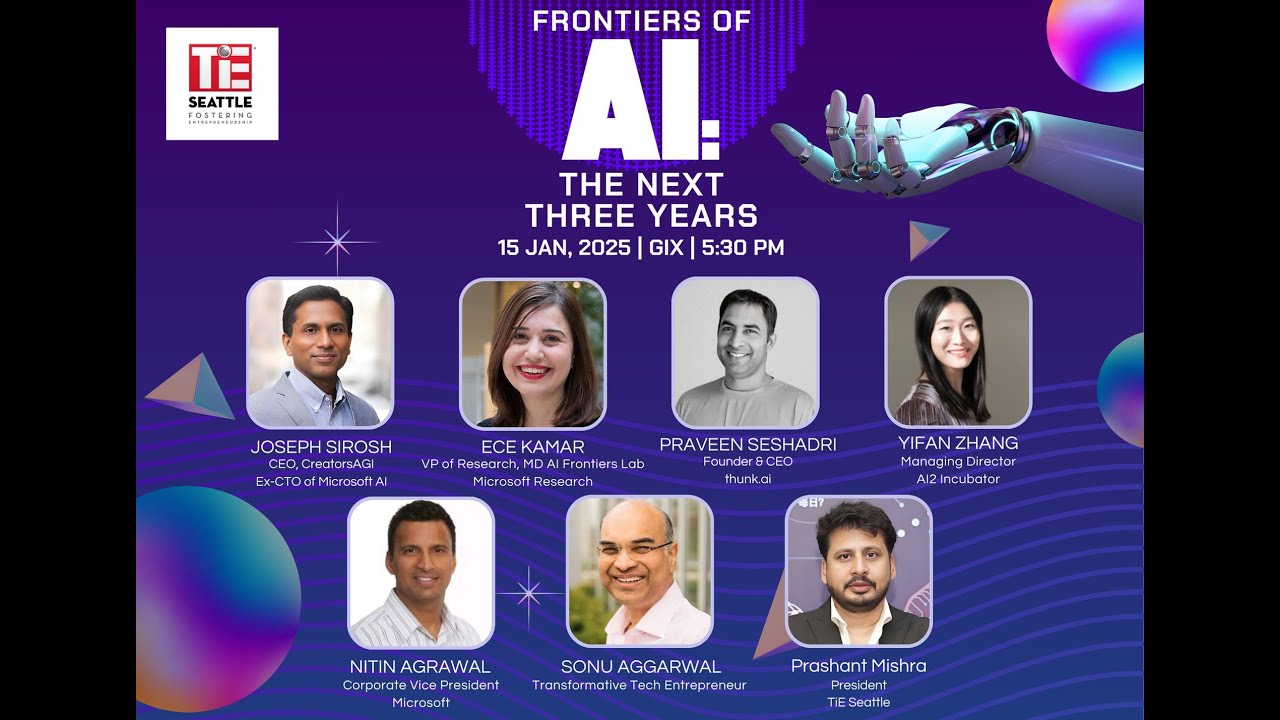
Frontiers of AI: The Next Three Years
Watch on
What an Unforgettable Evening! A huge thank you to our distinguished panelists—Joseph Sirosh, Ece Kamar, Nitin Agrawal, Praveen Seshadri and Yifan Zhang —for sharing your invaluable insights at Frontiers of AI: The Next Three Years. Your thought-provoking perspectives left the audience inspired and in awe. The feedback has been overwhelmingly positive, with many praising the depth of discussion and the perfect balance of viewpoints. We’re deeply grateful for your expertise and for making this event a memorable success. Special thanks to our program chair, moderator, and sponsor, Sonu Aggarwal, for expertly guiding the conversation and highlighting these key takeaways: 1. AGI (Artificial General Intelligence) & ASI (Artificial Super intelligence) are key milestones framing the evolution of AI over the next several years. The definition of those milestones can be widely interpreted, however. One definition of AGI has to do with the ability to learn anything just like a human can, for example. 2. Over the last decade, scaling up large language models (LLMs) has been a particularly fertile source of AI innovation, often unexpectedly yielding newly intelligent behaviors. However, OpenAI & others are running into fundamental performance limitations scaling their large language models further (e.g. OpenAIs GPT-5 project, Orion, has entailed $0.5B in training cost per 6-month run, for modest improvement and is well behind schedule). These limitations are governed by power laws expressing model performance as a function of model size, amount of training data and amount of training compute applied. 3. However, a number of recent innovations in AI are framing further innovations in over the next three years, breaking through the scale limitations of pre-training. 4. For example, Large Multimodal Models (LMMs) exceed the performance of LLMs by learning across multiple channels - text, video, audio etc. simultaneously. 5. Action models work with action tokens translating an action stream into a predicted next action. 6. Reasoning models apply reasoning at interference time to generate step by step results for vastly better results despite taking a little longer to process (“inference time compute”). 7. Finally, agentic workflows are showing incredible promise in tackling complex tasks with great results. 8. The Computer Use scenario incorporates all of the above innovations, and will fundamentally transform the way we work over the next three years. 9. The opportunities for new entrepreneurs are likely to continue to be focused on vertical applications of these innovations (though work is underway to make large foundation model innovation much more accessible at smaller scale or at the edge). 📸 Check out a few moments from the event below! More pictures will be uploaded soon on our event page—stay tuned! 🔗 https://lnkd.in/gCmPwVsF #FrontiersOfAI #AIInnovation #FutureOfAI #TechLeadership
 Joseph Sirosh
Ece Kamar
 Nitin Agrawal
 Praveen Seshadri
 Yifan Zhang
 Sonu Aggarwal
